PolySouq: USDC on Polygon, Bitcoin Every 5 Minutes
Key takeaways
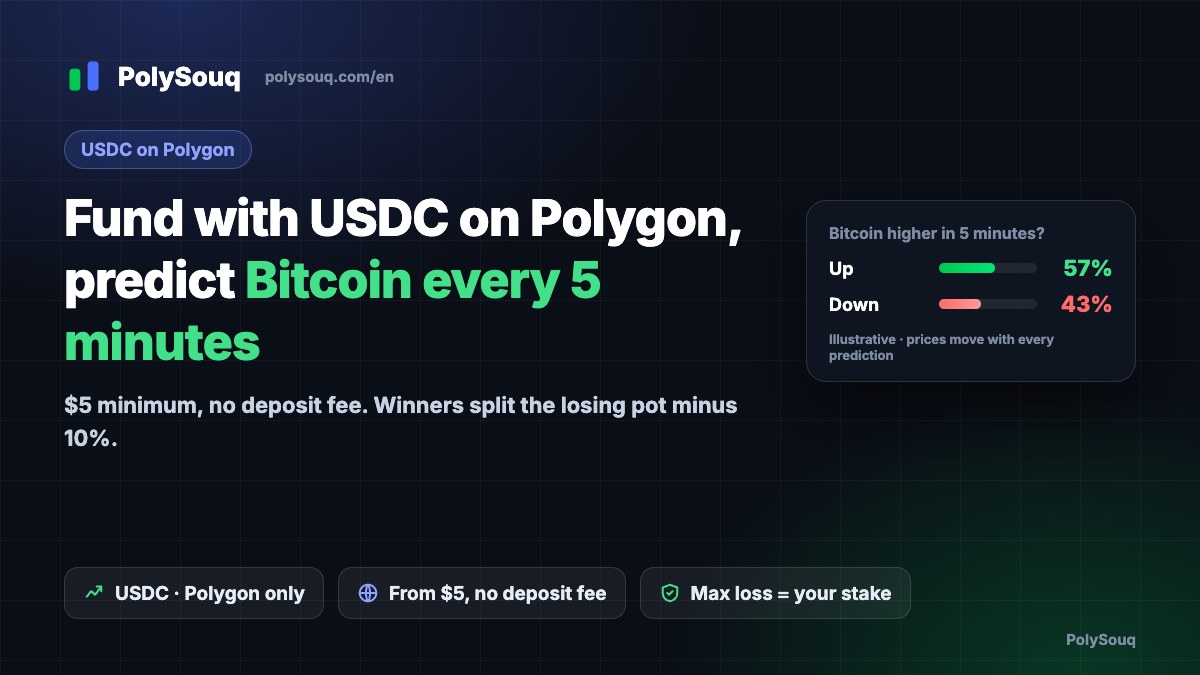
- Deposits and withdrawals are USDC on Polygon only. USDC sent on any other network is not credited.
- Minimum deposit $5, minimum withdrawal $5, no deposit fee, balance displayed in $.
- Bitcoin and Ethereum Up/Down windows run every 5 minutes, plus 4-hour, daily, weekly and monthly markets.
- Winners split the losing side's money after a 10% commission taken only from that losing pot.
- Buy-only, no leverage: the most you can lose is your stake, and you can lose all of it.
What PolySouq is, and what it is not
PolySouq describes itself as the first Arabic prediction platform, and it is the arab prediction site most Gulf users land on first: a place to trade the outcome of real events — a football match, a Bitcoin price window, an OPEC decision, a Saudi IPO — by buying YES or NO at the probability the market currently shows. The interface is Arabic-first and right-to-left, but the English version at /en carries every market.
Two things separate it from the exchanges and CFD brokers this site normally compares. First, you never hold a coin or a contract on a coin; you hold a position on a question, and the question resolves. Second, it is buy-only. There is no order book to sell into before resolution, so a position is held until the event settles. That replaces stop-losses and margin calls with one number you decide before you click: how much you are prepared to lose if you are wrong.
The platform is operated by a Cyprus-registered company, and its terms are governed by the laws of the Republic of Cyprus. It is a real-money product: balances are USDC you deposit yourself, shown in dollars.
Funding: USDC on Polygon, step by step
This is the part that matters most for anyone arriving from the crypto side. PolySouq accepts one asset on one network — USDC on Polygon — for both deposits and withdrawals. There is no card, bank or fiat option, which for a USDC holder is a feature: no conversion fee and no waiting on a payment processor.
The deposit flow lives in Portfolio → Add funds. Open it and you are shown a personal Polygon deposit address that belongs to your account. Send USDC to it from any wallet or exchange account that supports Polygon, and the balance appears once the transfer confirms on-chain.
- In your wallet or exchange, choose USDC as the asset and Polygon as the network. If the withdrawal screen offers several networks, Polygon must be the one selected.
- Paste the personal deposit address from Portfolio → Add funds. Send at least $5; smaller transfers do not meet the minimum.
- Wait for confirmation. Polygon settles in seconds to a couple of minutes; your $ balance updates when the transfer is final.
- Withdrawals go back out the same way — USDC on Polygon to an address you specify — with a $5 minimum.
- Warning: USDC sent on any other network (Ethereum mainnet, Arbitrum, Solana, Base, Tron or anything else) is not credited. The same is true of any token other than USDC. Check the network selector before you confirm.
| Item | PolySouq |
|---|---|
| Deposit asset | USDC only |
| Network | Polygon only |
| Minimum deposit | $5 |
| Minimum withdrawal | $5 |
| Deposit fee | None |
| Monthly or account fee | None |
| Balance shown as | $ (USD) |
| Fiat, card or bank | Not available |
The 5-minute Bitcoin and Ethereum windows
The crypto section runs Up/Down markets on Bitcoin and Ethereum in rolling 5-minute windows. Each window opens with a reference price; you buy Up if you expect the price at the close of the window to be higher than the reference, Down if lower. When the window closes, the market resolves against the reference feed and the next window is already open.
The same Up/Down structure runs at 4-hour, daily, weekly and monthly durations, so a view on where Bitcoin trades at month-end is expressed the same way as a view on the next five minutes: one question, one price, one stake.
You are not buying Bitcoin, not opening a perpetual and not borrowing. A $10 Up position on a 5-minute window can only ever cost you $10.
| Window | What resolves it | Typical use |
|---|---|---|
| 5 minutes | Price at window close vs reference | Very short-term momentum views |
| 4 hours | Price at window close vs reference | Session-level views |
| Daily | Close vs open of the day | Macro or news-driven days |
| Weekly | Close vs open of the week | Positioning around events |
| Monthly | Close vs open of the month | Longer-range views |
How the parimutuel payout works: a worked example
PolySouq does not match you against a market maker and does not quote a spread. Every market is a parimutuel pool: all the money placed on each answer sits in that answer's pot, and when the event resolves, the people who backed the correct answer split the money placed on the incorrect answers. The platform's commission is 10%, taken only from the losing pot — never from your stake, never from a deposit.
Take a 5-minute Bitcoin window. By the close, $100 has been placed on Up and $50 on Down. You placed $10 on Up. Bitcoin finishes above the reference price, so Up is correct.
- Losing pot: $50 (everything placed on Down).
- Commission: 10% of $50 = $5, taken from the losing pot.
- Distributed to the Up side: $50 − $5 = $45.
- Your share of the Up pot: $10 ÷ $100 = 10%, so you receive 10% of $45 = $4.50.
- Your payout: $10 stake back + $4.50 = $14.50.
- If Bitcoin had finished below the reference, you would have lost the full $10 — nothing more, nothing less.
| Line | Amount |
|---|---|
| Money on Up (correct) | $100 |
| Money on Down (incorrect) | $50 |
| Commission, 10% of the losing pot | $5 |
| Net pot shared by Up backers | $45 |
| Your stake on Up | $10 (10% of the Up pot) |
| Your share of the net pot | $4.50 |
| You receive | $14.50 |
| Your maximum possible loss | $10 |
Refunds, buy-only rules and what "no leverage" means here
Because the payout comes from the other side of the pool, a market with no losing side has nothing to distribute. If you are the only participant, or if every participant backed the correct answer, every stake is refunded in full to the wallet. Voided or cancelled markets are refunded in full as well. In practice this means a lonely position on a thin market is a refund, not a loss.
Buy-only is the other rule to internalise. You can buy YES, NO, Up or Down; you cannot reduce or reverse a position before the market resolves. Size accordingly — the honest framing is that you decide your maximum loss at the moment you buy, and that maximum is exactly your stake.
There is no leverage, no margin and no liquidation engine, because there is nothing to lever: a pool pays out what is in it.
Everything else you can trade
Bitcoin windows are the crypto-native entry point, but the catalogue is mostly multi-answer events with three or more outcomes: who wins a league, which range a price closes in, what a central bank decides. Each category below has its own live page.
| Category | Examples | Link |
|---|---|---|
| Crypto Up/Down | Bitcoin and Ethereum, 5-minute to monthly | Crypto |
| Forex and commodities | Gold (XAUUSD), oil (USOIL), EURUSD, USDJPY, silver Up/Down windows | Forex |
| Football | Champions League, Premier League, La Liga, Serie A, Bundesliga, Ligue 1, Saudi Pro League 1X2 | Champions League |
| Saudi market | TASI moves, IPOs, Aramco events | Saudi Arabia |
| UAE | DFM and ADX events, Dubai real estate | UAE |
| Politics and geopolitics | Elections, summits, regional decisions | Politics |
| Economics | OPEC output, interest rates, CPI prints | Economics |
| Real estate | Dubai and Gulf property milestones | Real estate |
Opening an account in six steps
Sign-up is email and password, Google, or Apple. Email verification is required before you can trade or comment, and the interest picker at the end builds your personalised feed.
- Open the sign-up page and create the account with email, Google or Apple.
- Verify the email address. Trading and commenting stay locked until this is done.
- Pick your interests. Crypto, forex, football and Gulf markets each feed the home page differently.
- Go to Portfolio → Add funds and copy your personal Polygon USDC address.
- Send USDC from any wallet or exchange that supports Polygon, choosing the Polygon network, $5 or more.
- Open an event and buy YES, NO, Up or Down. The position resolves with the market.
Friends, the accuracy leaderboard and the ideas feed
PolySouq frames itself around testing your knowledge rather than beating a house, and the social layer is built to match. From Settings you get a personal invite link; friends who join through it can be challenged on the same events through the play page, and the weekly accuracy leaderboard ranks users by how often their predictions were right, not by how much they made.
The parimutuel structure has a useful side effect for duels: if you challenge a friend and nobody takes the other side of a market, there is no losing pot, so your money simply comes back. You cannot be left holding a one-sided position.
For analysis there is Ideas, a community feed with posts, replies, mentions, bookmarks and profiles, plus a comment thread under every event. A verified email is required to post, which keeps the feed readable. Alongside it sits Research, the platform's own explainer library on how a prediction market website prices, settles and pays out events.
Transparency, culture and who runs it
Settlement is automated by consensus of public sources; anything the automation is unsure about goes to a human review queue rather than being forced. Every resolved market shows its outcome and the source it resolved against, and the leaderboard is public, so a user's record can be checked rather than claimed.
The platform is explicit that it respects Arab culture and values: it does not list events that contradict them, it does not frame a prediction as a wager anywhere in the product, and its own tagline for the experience is "test your knowledge". The interface defaults to Arabic, Saudi time and Gregorian dates.
Mike Brend, PolySouq's Chief Marketing Officer, puts the design choice this way: "We built the payout so that the only money you can lose is the money you chose to put on a question. No leverage, no liquidation, no fine print. If you were right, you share what the other side was wrong about, and every settled market shows you why."
Why now: the US numbers and the Arab-world gap
The category has stopped being niche. Pew Research Center (May 2026) reports that combined monthly global trading volume on Kalshi and Polymarket rose from under $5 billion in September 2025 to about $24 billion in April 2026. Since July 2024, crypto has accounted for 7% of Kalshi's volume and 20% of Polymarket's; sports leads both. CoinDesk (April 2026) puts Kalshi at about 89% of the US regulated prediction market.
None of that activity has had an Arabic-language home. Polymarket and Kalshi are English-only and focused on US and European events; a Saudi index move, a Gulf IPO or a Saudi Pro League fixture rarely appears on either. That is the gap PolySouq is built for, with USDC on Polygon as the rail that lets a crypto holder anywhere in the region fund it in minutes.
Is PolySouq a betting site?
No, and the difference is structural rather than cosmetic. A sportsbook or bookmaker sets the odds itself, takes the other side of your position and profits when you lose; the house is your counterparty. On PolySouq the price is set by what other users have put on each answer, the platform never takes a side, and its commission is a fixed 10% of the losing pot whoever wins. There is no house edge hidden in the odds and no incentive that depends on you losing.
That is why it is a prediction market rather than a betting product: the price is a live estimate of probability produced by people with money on the line, and the record of who was right is public. It is still real money and you can lose all of a stake — but to other users who were right, at a price you could see.
Frequently asked questions
What network do I use to deposit USDC on PolySouq?
Polygon only. Open Portfolio → Add funds, copy your personal deposit address, and send USDC from any wallet or exchange with the Polygon network selected. USDC sent on Ethereum, Arbitrum, Solana, Base or any other network is not credited, so check the network before confirming.
What are the minimum deposit and withdrawal amounts?
Both are $5. There is no deposit fee, no monthly fee and no spread; the platform's only charge is a 10% commission taken from the losing side's pot when a market resolves. Your balance is displayed in dollars, and withdrawals go back out as USDC on Polygon.
How do the 5-minute Bitcoin markets work?
Each window opens with a reference price. You buy Up if you expect Bitcoin to close the window higher, Down if lower. At the close the market resolves against the reference feed and the next window is open. The same Up/Down structure runs at 4-hour, daily, weekly and monthly horizons.
How is the payout calculated?
Winners split the money placed on losing answers, minus a 10% commission taken only from that losing pot, in proportion to their stake. With $100 on Up, $50 on Down and your $10 on Up, a correct Up call returns your $10 plus $4.50, a total of $14.50.
Can I sell or close a position before the market resolves?
No. PolySouq is buy-only: you buy YES, NO, Up or Down and hold it until the event settles. This is why sizing matters — your maximum loss is fixed at the moment you buy and equals your stake. There is no leverage, margin or liquidation.
What happens if nobody backs the other side?
Every stake is refunded in full. A parimutuel market pays winners from the losing pot, so if you were the only participant or everyone backed the correct answer, there is no losing pot to share and the money returns to your wallet. Voided markets are refunded the same way.
Can I use PolySouq in English?
Yes. The platform is Arabic-first, but the English interface carries every market — Bitcoin windows, football, Saudi and UAE events, politics and forex. Times default to Saudi Arabia and dates are Gregorian. A mobile app exists alongside the web version.
Who operates PolySouq?
A Cyprus-registered company; the terms are governed by the laws of the Republic of Cyprus. Settlement is automated by consensus of public sources with a human review queue for uncertain cases, every resolved market shows its outcome and source, and the accuracy leaderboard is public.
Sources
- Pew Research Center: trading volume on prediction markets has soared (May 27, 2026)
- CoinDesk: Kalshi now controls 89% of the U.S. prediction market (April 9, 2026)
- Prediction market — Wikipedia
- USD Coin — Wikipedia
- Polygon (blockchain) — Wikipedia
Read next
We earn a commission on some links. It never changes the ranking — our method is published and the data is sourced.
Crypto is volatile and largely unregulated. CFDs are leveraged and most retail accounts lose money. Never risk money you cannot afford to lose.
Information only. This is not investment advice.